Tuesday, 14 November 2017

Lifesaving Poems - A Review


Lifesaving Poems (edited by Antony Wilson, 2015, Bloodaxe Books)

This collection, edited by Anthony Wilson and containing his choice of favourites with a short essay after each one, has an unfortunate title.  It inevitably reminds one of those books that promote poetry as a form of self-help or therapy: poems to relax you, poems to inspire, poems that make men cry... Yes, poetry has been co-opted by the life coaching brigade, but I suppose anything that gets more people reading it can only be a good thing. And a good poem can stand up to any sort of treatment. 
                But following my recent experience of bereavement, I can see why people turn to poetry for help and consolation. When the odd bout of grief hits me, it’s a queasy, destabilising sensation that feels like someone has given a jar of water a shake and a layer of sediment has risen from the bottom and turned the water cloudy. Poetry, which often reminds me of what’s there in front of me, such as permanent features in nature and in our lives, has served to help me maintain some sense of equilibrium at a disturbing time.  
                In Lifesaving Poems, Wilson, a poet and a teacher, selects and comments on, poems that helped him become a poet, poems that stunned him and on poems that helped him through cancer. As he writes in the introduction, the book ‘is a thank you to the people who have shared a love of poetry with me.’ Despite the title and occasionally grim subject-matter, his choices are devoid of drama and sentimentality. Like all the best poems, they look at life in an unflinching manner, and they aren’t afraid to pick up the stone and observe what’s going on underneath. And that’s what the best poets do, I suppose: look hard at the things most of us turn away from or want to avoid thinking about.
                Wilson includes fantastic poems by the likes of Jo Shapcott, Raymond Carver and Sharon Olds and his short essays neatly balance analysis with personal reflection; his observations are always illuminating but they never steal the spotlight from the poems themselves.
                What’s most endearing about this book is the editor’s giddy enthusiasm for the poems and his championing of unknown or forgotten poets such as Stephen Berg, whose New and Selected Poems, Wilson writes, is available on Amazon for 13p.  Of Martin Stannard, he claims ‘had he come from New York or Zagreb, we would all be called him a genius by now.’  Poets need proselytisers and the ones included in this collection are lucky to have one like Wilson.

Thursday, 9 November 2017

10 Rillington Place - Film Review


                The story of the killing of Beryl Evans by her landlord John Christie and his subsequent framing of her husband Timothy, Richard Fleisher’s 10 Rillington Place is a queasy masterpiece.  Murder apart, the depiction of Christie’s flea-pit of a boarding house is unpleasant enough in itself: ragged carpet lifts off the stairs, the cramped hallway is lit by a single dim lamp, he and his wife’s tiny quarters have barely enough room for a rope webbing deckchair and a medical cabinet containing the rubber tube he uses to gas his victims.


            The tenants are a sadly pathetic young couple, a feckless braggart played by John Hurt and his guileless wife (Judy Geeson) who are already struggling to support their baby daughter when they move into Christie’s house.  After discovering she is pregnant again, when Geeson decides to have an abortion, both she and Hurt show tragic naivete in putting their trust in the mild-mannered Christie, who assures them he has the medical experience to be able to help Beryl.


             The unsettling nature of the film has much to do with the realistic look of the production – there is nothing idealised in this portrayal of grimy post-war poverty – and the horribly inevitable manner in which the poor (and poorly educated) are exploited not only by Christie but also by the law.


              But the key element in making this such a disturbing experience is the chilling lead performance of Richard Attenbrough who moves soundlessly and half-whispers his way through the film. We often hear about the cold, calculating behaviour of psychopaths; as Christie, Attenbrough captures this perfectly. His calm and reasonable manner and apparent preoccupation with making tea is brilliantly complemented by the volatile, agitated Hurt, playing the perfect foil for his manipulative landlord.


                The BBC produced a second adaptation of the story, the three-part Rillington Place, in 2016.

Wednesday, 8 November 2017

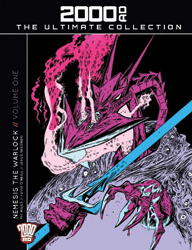
Loving the Alien: Nemesis the Warlock


The fifth issue of 2000AD: The Ultimate Collection features the frankly mind-bending Nemesis the Warlock. When people talk about the subversive side of 2000AD, it’s this truly bizarre story that quickly springs to mind. Pat Mills’s future version of an earth where quasi-religious fanatic Torquemada demands the annihilation of all aliens (or ‘deviants’ as he calls them) is brought to life by Kevin O’Neill’s startlingly grotesque, Bosch-like visuals in which clothes and buildings have a medieval/sado-masochistic look and everything appears to be alive.
                 It’s a strip that pulsates with anger, the work of two former Catholic schoolboys gleefully giving the finger to rigid authoritarian figures and dogma of all kinds. It’s somewhat hard to believe that this stuff was first published in the early-1980s, in a weekly comic aimed at pre-teens, one that shared the same stable as Tiger and Roy of the Rovers but, as managing editors from the time have since explained, it would have been foolish to tamper with a winning formula. And at that point, 2000AD had become a huge success with a significant readership among teenagers and college students.   

The titular character is the leader of an alien resistance force dedicating to alleviating the lot of those suffering under the yoke of the intolerant humans of Termight. The joy of the tale is in how readers’ expectations are confounded as the frequently hideous aliens are presented as sympathetic victims of the Klan-like human mob.  Kevin O’Neill’s artwork is sometimes so surreally detailed and deliberately unpleasant, it can be hard to look at but there are many unforgettable images here such as Nemesis’s Great Uncle Baal’s study with its fantastic collection of oddities including a chair made from a human skeleton, the joust between armour-clad female warlocks and the dizzying chase through the travel tube.

One of the most overtly political strips ever to appear in 2000AD, with its extreme depiction of what fear of ‘the other’ can drive people to do, Nemesis the Warlock remains as relevant as on its first appearance.

Wednesday, 1 November 2017

Brexit and the Attempts to Shut Down Debate


                  I read an article recently in which the writer claimed that the U.K. was having a collective nervous breakdown.  It’s certainly felt like that for this blogger. I’ve watched BBC’s Question Time every week since the European Union referendum (usually on Youtube a couple of days after the live transmission) as I am fascinated by the persistent mood of anger and frustration among audience members and by the members of parliament who were Remainers but since the vote have become zealous Brexiters.  If that programme is an index to the general state of the nation, it seems a few springs have come loose.

                While I am sad about the impending departure of Britain from the E.U. (it’s bad for Ireland, where I live, and bad for Europe) what makes me sadder still are the attempts of some to stifle debate.  On Question Time, one regularly hears panellists and audience members admonishing those who complain about the decision to leave and demanding that those who are sceptical of the government’s approach stop criticising them and leave them to get on with it. Those who question the decision to leave the community are branded sore losers and remoaners and even traitors who are intent on ‘talking down’ Britain and weakening its bargaining position.

                For someone who has for years watched British democracy with a great deal of admiration, this is a sorry state of affairs.

     Having lived six months in Britain, and having spent much of my life watching British television and reading British newspapers, I have always been struck by how much complaining people do over there and this extends to the country's media. Reading the home news in any British newspaper and you would think the U.K. was teetering on the brink of collapse (failing schools, struggling health service, creaking infrastructure).  Unlike most people in Ireland, the British have long been highly critical of public services and government and this is partly due to a lingering notion that life on that island was better in the  decade or so after World War II. 

                But I think this propensity to complain and criticise is also linked to the fact that the U.K. is a mature, stable democracy where people know that the state can withstand scathing attacks. Complaint and criticism are expressions of freedom and confidence. Ireland is still an immature state where many people are afraid to ‘talk down’ the country by pointing out its flaws. During my lifetime, that has not been the case with the U.K….until now.

                I’ve always considered Britain to be a complex place but one in which reason and pragmatism were the chief values of its people and its parliament: many of the greatest Enlightenment thinkers were British, its political system has been remarkably stable for more than 350 years, and the U.K. has been in the vanguard of countries that have introduced progressive

policies for society at large.  Fascism has never put down strong roots in Britain partly because the people genuinely cherish freedom of expression.

                And that is why headlines like ‘Crush the saboteurs’ or the sight of columnists, politicians and members of the public telling dissenters to shut up and allow the government to do its work, are so depressing. Debate is the one essential component of a democracy and if this is dampened in one of the world’s most argumentative countries, it spells trouble for everyone.

Saturday, 21 October 2017

Shades of 'Broken Britain' in the Scream! and Misty Special.


              ‘Not for the Nervous!’ was the warning the first Scream! comic carried on its cover. But the free gift of a set of plastic vampire teeth and the fact that it was printed on IPC’s standard toilet roll quality paper made it look a bit silly.  Like so much of that publisher’s output, it looked cheap, dowdy and even a little desperate.  I didn’t read it during its short run and only discovered it a few years later when a stack of unsold copies was being sold half-price in a suitably dusty old newsagent’s.

                By that time I had become a regular reader of 2000AD so the gothic humour of Scream! did appeal though it lacked the frequently mind-bending quality of the Galaxy’s Greatest. Despite its very short run (it was cancelled during a publisher’s strike after its fifteenth issue) Scream! attracted a band of hardcore devotees who helped the comic maintain an online presence and re-published some of the stories. More recently, Rebellion’s purchase of IPC’s stable of comic characters in 2015 led to the publication of collected editions of Scream! strips Monster, The Dracula Files with The Thirteenth Floor to receive the same treatment in 2018. It’s an impressive feat for a weekly that only lasted for four months.

               Scream!’s predecessor, the Pat Mills-created girls’ comic Misty (1978-1980) was an anthology of supernatural stories that also had an impact that belied its relatively short lifespan.  And some of its best stories have been reproduced in collected form too, beginning with last year’s pairing of Moonchild with The Four Faces of Eve.

                 As well as republishing old stories, Rebellion have been able to create new adventures for the old characters and their first attempt has led to the Scream! and Misty Special.  But this is much more than a nostalgia fest for those of us in the throes of a mid-life crisis…

                  What is particularly striking about this comic is the way in which the re-booted stories, like all good horror tales, reflect contemporary concerns. In the Special version of The Thirteenth Floor, in which Max, the deranged computer who controls a tower block, exacts punishment on wrongdoers by bringing them by lift to the mind-shattering location of the title, there are echoes of the Grenfell disaster when it is revealed that the building fell into ruin and was then cheaply restored.

                Unsavoury echoes of modern Britain are also apparent in The Sentinels, in which there are hints of the worst emissions released by the Brexit debate.  In a rundown area on the outskirts of the city (urban decay is a running theme) a cranky older man shouts racist abuse at a teenage boy wearing a turban.  Overlooking the scene is an abandoned tower block (again!) which functions as a portal into an alternative reality where the same man is the totalitarian leader of a Britain that was defeated in World War II.  

                 But the original Scream! never took itself too seriously and there is plenty of levity in these pages. Those old enough to remember IPC characters from the early to mid-1970s will doubtless get a kick out of seeing the revival of the tremendously eccentric Black Max (a perma-grinning World War I pilot assisted by an army of bats!) and the host of vintage characters who make up the supporting cast of Death Man, while the joint editorial team of the putrescent Ghastly McNasty and the ethereal Misty makes for a comical clash of styles.

                  What will perhaps be most gratifying for older readers (and the vast majority of readers will be older) is seeing these characters and stories at last in full colour, and on high quality paper, and seeing once again the jagged Scream! logo jumping out from the newsstands.  A worthy revival.  

Tuesday, 10 October 2017

Blade Runner 2049


A review of the new Blade Runner film? There can’t be too many of them on the internet… Yes, here I am adding to what must certainly be floods of opinion on Denis Villeneuve’s sequel to the much fetishised 1982 original.  Is it coldly beautiful? Yes. Is there an overwhelming sense of alienation and emptiness? Yes.  Is Ryan Gosling a convincing lead? Yes. 

                So why do I feel slightly non-plussed about the experience? Maybe it’s because the original worked so well on its own, with its riddles and mysteries generating so much debate among fans. Maybe it’s because the sequel doesn’t add much to the overall story of Decker, the replicants and the future L.A. –  the idea that replicants were made with the ability to become pregnant is intriguing but the virtual girlfriend feels a little passe and bland (the same idea was explored with greater success in Spike Jonzes’s Her). Whatever the sequel was saying, it felt like much of it had already been said in the original.

With its slow pace, waves of synthesisers on the soundtrack and faithful recreation of the dark and rainy, neon-lit sets, the film often feels like an homage to the original and I wondered if the director might have spent more time beyond the city limits (some of the best scenes were in San Diego's mega dump). I wondered whether the studio might have been better off investing in a brand new idea – Villeneuve’s own Arrival and Jonathan Glazer’s Under the Skin are much more interesting science fiction films that were not burdened by the heavyweight legacy of a famous predecessor, they cost a lot less to make but were infinitely more impressive.

After much musing, I came to the conclusion that my main criticism of the film (and I did actually enjoy it!) is strongly linked to what I know about the tortured production of the original. As wonderful as CGI animation can be, when you know about the restrictions and obstacles faced the crew on the 1982 film – having to film at night-time throughout the shoot with buckets of waters falling constantly, having to make a model the size of a large jigsaw puzzle ‘become’ the Los Angeles of 2019 – it’s hard to be really impressed modern-day special effects that can be created indoors, in all seasons, without even having to build anything, and can then be tinkered with later, in endless ways.

Blade Runner 2049 has some excellent moments but should perhaps be considered on its own terms rather than in close connection to its predecessor. It’s spectacular but most of the ‘wows’ feel re-heated. And there’s no replacing Rutger Hauer and Darryl Hannah.  

Sunday, 17 September 2017

The Ballad of Halo Jones


2000AD: The Ultimate Collection:
The Ballad of Halo Jones

By Alan Moore and Ian Gibson
     

                2000AD’s enduring success has much to do with the fact that it ‘grew up’ with its readers in the mid to late 1980s. The seven to ten-year-olds who were thrilled by the ultra-violence and broad satire of the early progs would, in their late teens, be ready for more sophisticated and knowing stories of war psychosis and post-modern superheroes. I didn’t grow up with the comic. The increasingly ‘mature’ storytelling left me cold and Grant Morrison’s Zenith with its references to the nascent acid house scene and to British politics was the first story I’d read in the comic which felt like it hadn’t been written for me.  So I lost interest in the weekly and retreated into the simpler classics being reprinted in the Best of 2000AD monthly.

                The Ballad of Halo Jones, which has just been reprinted and issued in hardback form as part of Hachette’s 2000AD: The Ultimate Collection, was an earlier attempt to move the comic away from the ‘grim guys with guns’ formula of most of the strips and with its nearly all-female cast of characters and its focus on the life of an ordinary woman seeking to escape from a life in a monotonous urban district of the future, it did move into brand new territory.

                I don’t remember disliking the story when I read it in its original form in the weekly prog but I was certainly more intrigued than entertained by it. Reading it now, over thirty years later, I can see why. The 50th century is presented as a world in which finding work is a hideous struggle, where dolphins are on an equal footing to human beings, where slender, delicate women are soldiers in horrific interplanetary wars. Alan Moore’s scripts are endlessly inventive but always plausible and his characters are at times heart-breakingly realistic while Ian Gibson’s art becomes more beautiful and striking with each episode. By the time of the third book, Gibson draws his heroine’s face with a level of subtlety and sensitivity that had never been seen before in 2000AD. 

                I was tickled to read on the inside of the front cover that this collected edition of the story is not recommended to readers under 15. My ten-year-old self, who first encountered Halo Jones when he bought 2000AD prog 382 in his local newsagents, would find that pretty amusing.